The Rise of the T-Shaped Artist
Pure specialists are struggling. Pure generalists are competing with $20 tools. The answer is the T-shaped artist, deep craft plus pipeline understanding, and it's what the next five years will reward.
The Rise of the T-Shaped Artist
I want to put something down clearly, because I keep watching smart people arrive at the wrong answer.
Every week I see talented, experienced people in animation, VFX, and games spiral into panic about AI. Some are gripping their specialties like a life raft. Others are throwing everything out and calling themselves “generalists” because it sounds safer. Both groups are making the same mistake, and I think it’s worth talking about.
There’s a concept that’s been floating around management and design circles for a long time. It doesn’t come from our industry, but it applies to what we’re living through right now more perfectly than anything I’ve seen.
It’s called the T-shaped skill set.
Where the T comes from
The term first showed up in management literature in the early 1990s, credited to a researcher named David Guest. Tim Brown at IDEO picked it up and used it when he was building interdisciplinary design teams. McKinsey had apparently been using it internally even before that, to describe consultants who combined genuine depth in one area with broad collaborative reach across many others.
Nobody in animation or VFX coined this. We borrowed it, the way we borrow everything useful.
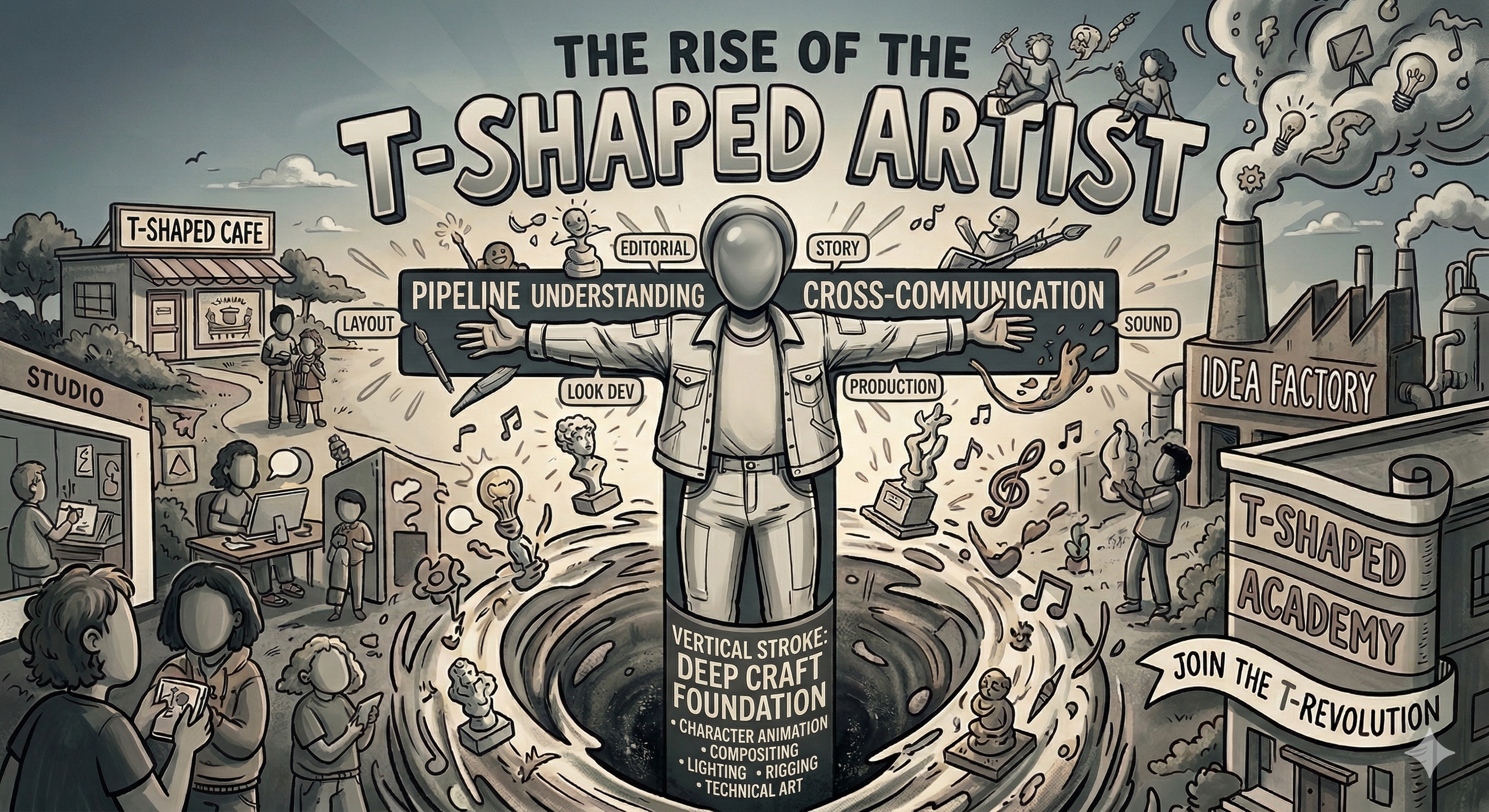
Here’s what it means for us. The vertical stroke of the T is your deep craft. Character animation. Compositing. Lighting. Rigging. Technical art. Something you can do at a genuinely high level, where you can tell when it’s good and when it’s broken, whether a human or a machine produced it. Without that foundation, everything else we’re about to talk about falls apart.
The horizontal bar is your pipeline understanding. Not just knowing your department, but knowing how your work connects to the next department, whether they’re in the next room or on the next continent. Understanding the language of layout, editorial, look dev, story, production, and sound well enough to communicate across them. Enough to hold a through line and be useful beyond your own zone.
When you put those two things together, a deep craft and a genuine understanding of the full pipeline around it, that’s what a T-shaped artist actually is.
Why this matters right now
AI is doing something fascinating and terrifying at the same time. It is very good at compressing the very bottom end of the vertical stroke. Roto. Prop modeling. Basic look dev. Simple tracking. Entry-level slap comps. The purely repetitive technical work that used to be where you built your hours and got your reps in, that work is being handed over to machines faster than most people are ready for.
A pure specialist whose entire value lives in that zone is in a difficult spot right now.
But here’s what AI is genuinely awful at, and will be for a long time: it cannot hold a project together. It cannot decide what a scene needs. It cannot maintain the creative and technical coherence of a story across 90 minutes or ten episodes. It produces choices, fast, and if you don’t know which choice is right, you end up with a beautiful mess that nobody knows how to fix.
That’s exactly where the T-shaped artist lives.
The person who can push AI and traditional tools to genuinely high quality in their specific deep zone, and who also understands the wider picture well enough to know what the project actually needs, that person is not replaceable. They can orchestrate. They can communicate. They can catch it when the machine gets it wrong, and they know why. They are the ones who turn AI output into something that actually serves the story.
Why “just go broad” doesn’t work either
I’ve heard a lot of “just learn everything, stay broad, be adaptable.” The problem is that broad without depth is already what a $20 tool subscription can do. If your whole value is that you can do a passable version of many things, you are directly competing with commodity tools, and that is not a race worth running. Those tools get less mediocre every six months.
The answer isn’t pure specialist. The answer isn’t pure generalist. The answer is both, in the right proportions, built intentionally.
Think about the smaller studios doing ambitious work with tight teams. What used to take twenty people is getting done by five or six, because everyone on the team understands not just their craft but the whole machine they’re operating inside. That’s where the industry is heading. Three-person teams, five-person teams, building things that used to require entire floors of a studio, but only if every person on the team is shaped like a T.
The part that worries me
Here’s what I keep coming back to. The education system is not producing T-shaped artists. It’s producing what I’d call I-shaped ones: deep in one thing (sometimes), narrow at the top, disconnected from the rest of the pipeline. Universities built for a different pace of change, optimized around a job market that doesn’t quite exist anymore.
The students who get hired and actually thrive are the ones who understand the pipeline as a whole, not just their lane in it. They know how a shot travels from concept through layout through animation through comp and into the edit. They have depth and understanding of this cinematic language well enough to be useful outside their own room.
That combination, that shape, is what the next five years are going to reward. And right now our industry is not training for it the way it needs to be.
I want to dig into what the T actually looks like to build in practice, what AI filmmaking means for the people who understand it versus those who don’t, and what I think needs to change in how we train and develop artists. That’s where this is going.
More soon.